















































Message Received: When Fandoms Win and Institutions Don’t
Published: July 22, 2025
Hey friends,
Another week, another round of headlines that feel more like a Netflix docuseries. Love Island fans mobilized like campaign operatives—3.5 million votes in 2.5 hours. Elon Musk teased a spoiler party for 2026. Trust in public institutions hit a new low. Meanwhile, the latest Epstein coverage is a reminder of what happens when trust breaks down and no one agrees on what’s real.
So what does this mean for communicators? The public is skeptical, fragmented, and more likely to trust communities and creators than institutions. From fandoms to federal agencies, this is a moment for clear, grounded messages that connect with real people.
Let’s dig into what we’re seeing—and what to do about it.
Social Listening: Love Island and the Power of Fandom
I hear that some BGers have a dedicated Love Island group chat. They’re not alone. Bars across LA paused everything to show the finale. But this season wasn’t just entertainment. It showed how fast digital communities can organize and influence outcomes.
What we’re seeing:
- Mass participation. More than 3.5 million votes in under three hours.
- Coordinated momentum. Fans built mini coalitions, used memes for messaging, and kept pressure on the vote.
- Fan content wins. The most viral posts weren’t branded. They came from passionate fans with a point of view.
What it means for communicators:
- Treat your audience like a fandom. Don’t just inform—invite them in.
- Use language and content that fits the culture, not just the campaign.
- Community and emotion are stronger than reach alone. Build both.
And colleagues–I’m still waiting for my invite to the Love Island chat.
Poll to Watch: Musk’s “America Party” and the 2026 Shake-Up
A new Echelon Insights poll shows that Elon Musk’s floated “America Party” could change the 2026 election map.
- Without it, Republicans lead Democrats 48% to 47%.
- With it, Republicans drop to 41%, Democrats rise to 45%, and Musk’s party takes 5%.
What this tells us:
- Even a small third party can shift momentum.
- Voters want more choices—especially those who feel overlooked.
- Don't assume alignment based on party. Speak to values, identity, and purpose.
Trust Collapse: Gallup’s Institutional Confidence Poll
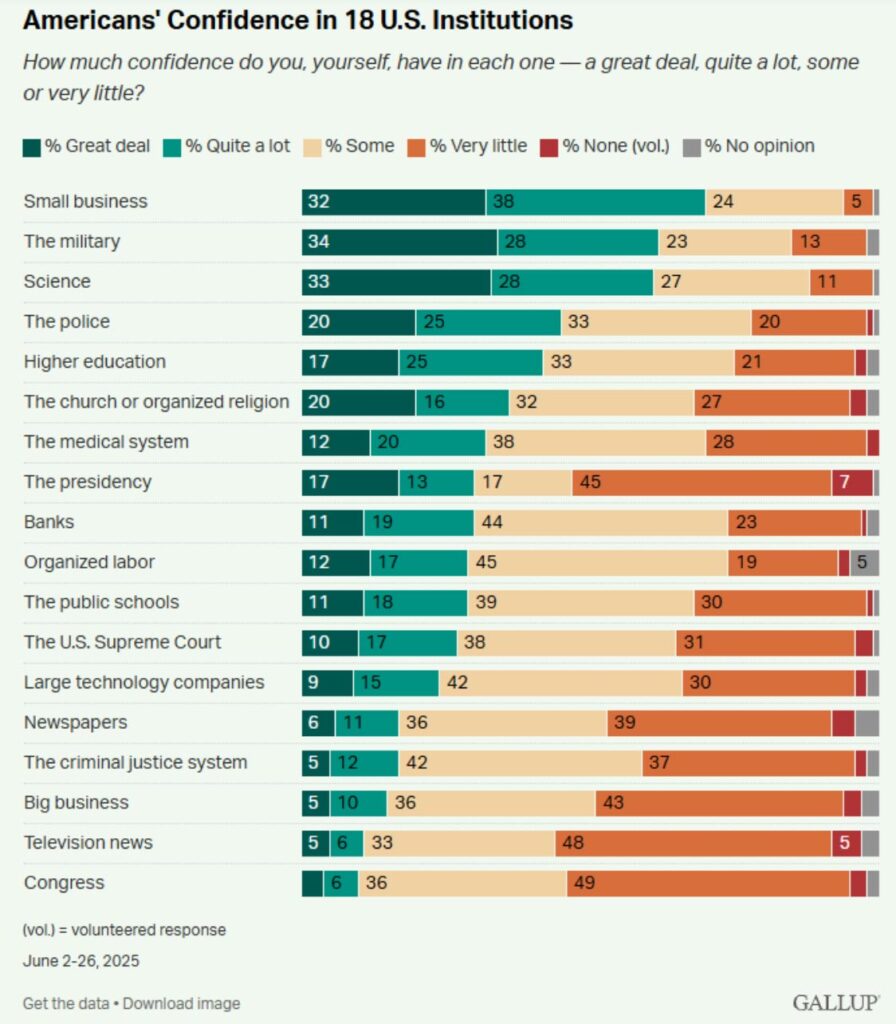
Gallup’s latest poll shows public confidence in major institutions is still in freefall—with the widest partisan divide in the poll’s 46-year history.
What stands out:
- Only 10% of Americans trust Congress.
- Confidence in the presidency and Supreme Court hovers around 30%.
- Partisan breakdown: Democrats’ trust is at a record low (26%), Republicans have slightly more confidence (37%, up from last year), and independents remain deeply skeptical (25%).
- The only consistently trusted institutions: small businesses, the military, and science.
What it means for communicators:
- Blaming Congress lands better than blaming Trump.
- Don’t ignore the trust gap—acknowledge it.
- For progressives, highlight local leaders and problem-solvers, not Washington gridlock.
Firm News
You're Invited: Crisis Communications For Education Leaders
Tuesday, August 5 at 9:00 am PT
Every school system will face tough moments, but not every tough moment needs to become a communications crisis. This session will cover common mistakes, what strong crisis response looks like, and quick tools to help your team respond with confidence when the pressure is on.
Shoot us an email to receive the Zoom link.
A Quick Breath
Big thanks to Kelly Ward Burton, who joined our retreat this year to teach us how mindfulness can sharpen the work of political operatives.
If you're reading this while multitasking, take a moment to reset with a box breath:
Inhale for 4 counts.
Hold for 4.
Exhale for 4.
Hold for 4.
Repeat.
Until next time
And with that, let us know what you’re working on. Remember, sometimes the clearest message comes after a pause.
—Bryson Gillette