















































Message Received: Juneteenth, Immigration, and the Fight for Freedom
Published: June 17, 2025
Hi Friends,
This week, we mark Juneteenth, a celebration of freedom hard-won and long-delayed, while bearing witness to scenes in Los Angeles and beyond that feel painfully at odds with that promise. Immigration raids. Mass arrests. Military troops in our streets. Political assassinations in Minnesota. It’s a stark reminder that freedom in America has always been unevenly applied and always contested. Below, we look at how this moment is unfolding and what it demands of communicators who believe in truth, dignity, and the power of voice.
Polling + Public Sentiment
Polling around this issue is ongoing, and we will continue to see updates throughout the week. Thus far, polling indicates that:
- President Trump’s handling of the protests is generally unpopular.
- Just 35% approve of Trump’s response to the protests, and 50% disapprove (Reuters/Ipsos poll of 1,136 U.S. adults conducted June 11-12).
- Nearly half disapproved of using Marines in LA (47% disapprove vs 34% approve).
- Nearly every metric is driven by a deep partisan divide.
- Republicans largely approve of Trump’s response to the protests and the deployment of the national guard to L.A.
- Indeed, 90% of Republicans supported troop deployment to LA; most Democrats and a majority of Californians opposed it. Independents leaned against by ~15 points (Washington Post–Schar poll of 1,000 U.S. adults, including 217 Californians, conducted on June 10).
- Views on the protests were sharply split. Californians and Democrats saw them as peaceful; Republicans largely called them violent.
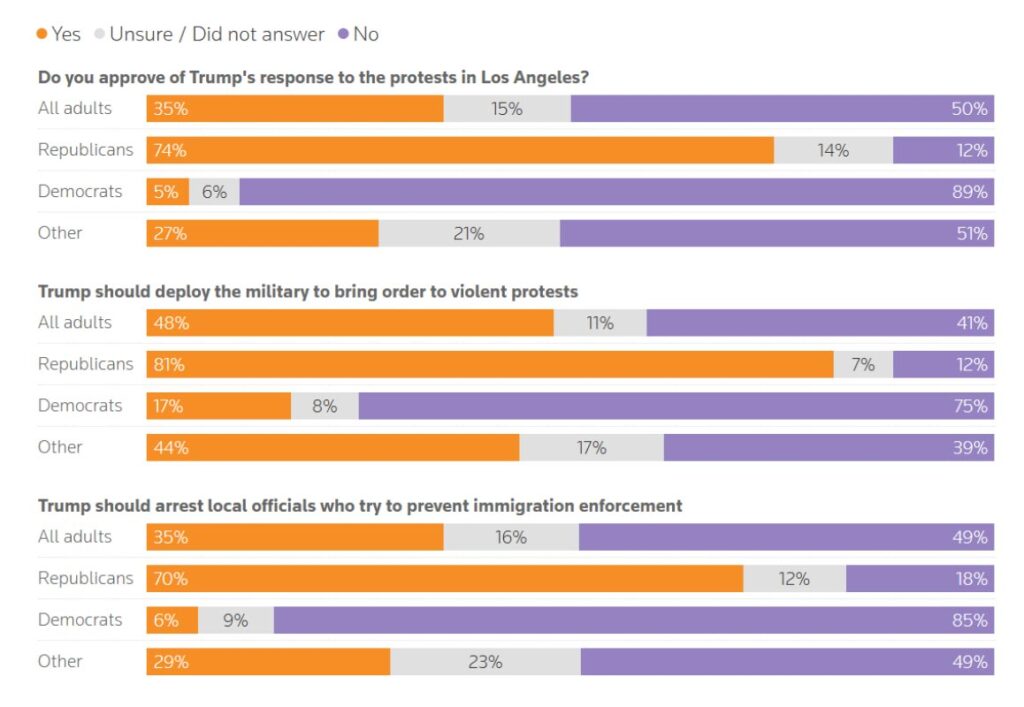
- Views on immigration broadly and on the protests in L.A. remain complicated and subject to the precise wording of the question being asked.
- While 52% support increased deportations of undocumented immigrants, nearly half (49%) say Trump has gone too far in his recent arrests (Reuters/Ipsos poll).
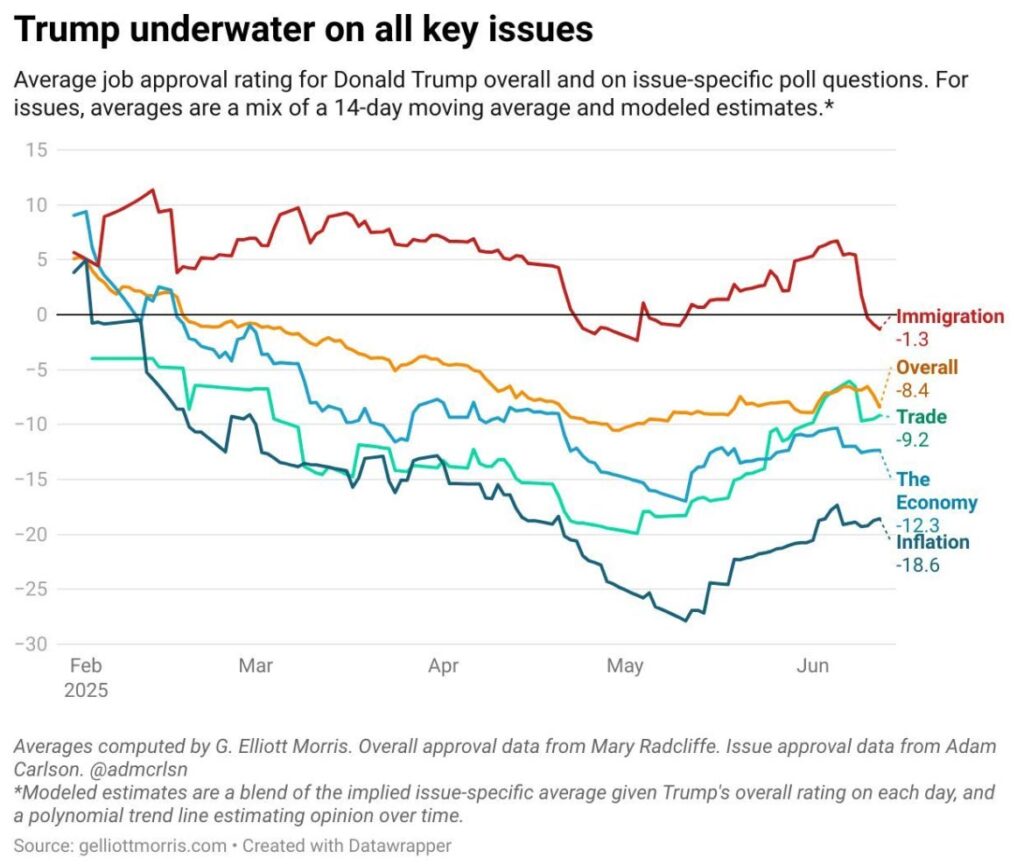
- And net approval of Trump’s handling of immigration broadly has recently flipped underwater (average computed by G. Elliott Morris).
-
- Roughly half (52%) think it should be illegal for Americans to attempt to prevent ICE from doing its job (note that “doing its job” does not place the question in the context of the situation in L.A.), yet nearly as many (45%) approve of the protests against ICE (Economist/YouGov poll of 1,512 U.S. adults conducted June 13-16).
- And while 58% think the protests in L.A. are a serious problem, including 34% of Democrats, another 45% feel the protests have been mostly non-violent and 43% feel the federal government’s response has been too aggressive. Only a quarter think the federal government’s response has been about right. (Economist/YouGov poll).
What This Means for Communicators:
- Be values-loud, not just message-clear. In moments like this, neutrality feels like complicity.
- Lead with humanity and legal literacy. Share stories of neighbors, not just tactics. Tie protest coverage to rights: First Amendment, due process, family unity.
- Amplify credible civic voices. Partner with local and national immigrant rights advocates, journalists, and city officials.
- Track tone shifts in real time. Public sentiment moves quickly when families are in the spotlight.
- But pay attention to the details. Words matter, and how one poll asks about immigration or protests or ICE may differ from how the question was asked in another poll. Take a minute to dig in and know what the data is really saying.
- Avoid narrative traps. Terms like “riot” or “invasion” are polarizing and obscure. Be precise, be grounded, be responsible.
Note: We’re eager to see how these numbers continue to evolve.
Social Listening: The Harvey Milk Ship
When Trump announced he would remove Harvey Milk’s name from a Navy ship (just two weeks ago, but it feels like a lifetime), the backlash was immediate and deeply personal for many. Mentions of Harvey Milk across social platforms spiked by more than 6000% in the two days following the announcement.
What we saw across platforms:
- LGBTQ+ advocates, veterans, and Gen Z users rallied in protest. On TikTok, clips of Harvey Milk’s legacy went viral alongside calls to honor his memory, not erase it.
- Meta and X were polarized, but among progressive voices, this move sparked renewed engagement and calls for institutional accountability.
- In California and beyond, the act was seen not just as political, but deeply personal. It was a slap in the face to generations of queer service members and activists.
- An old argument resurfaces. Supporters of the move emphasized an old criticism of Harvey Milk (a common tactic to discredit prominent gay figures).
- Leveraging the outrage machine. One high-engagement post placed this action into a larger strategy by the political right to lay strategic communications “traps” for left-focused organizations and figures. This strategy allows one group to bait the opposing group into elevating a relatively low-salience issue or talking point on social platforms and in the news through their outrage, allowing the original group to broadcast their views more easily.
What This Means for Communicators:
- Symbolic acts carry real weight. They shape collective memory.
- Go beyond hot takes. Ground your content in history and emotion.
- Learn the mechanics of outrage bait, and don’t play into them blindly.
Fun with AI: A Prompt That Made Us Smile
Since making time for fun is one of our core values, we’re also sharing this prompt from The Neuron, one of our favorite AI newsletters:
Prompt: “Create a four-panel comic based on what you know about me.” Let us know if it sparks anything funny, useful, or horrifyingly accurate.
Until next time
We’ll be right here, making some good trouble. Let us know what you’re up to or what you’re curious about. And thanks, as always, for being part of our orbit.
—Bryson Gillette